I do not believe that we have as many emperors or kings in the world today, but we do have rulers. Do we live in an era of empire-building? I do not think that is the case. Colonization does not appear to me to be the goal of foreign affairs in my lifetime at this moment. However, Russia did invade Ukraine and annexed the Crimean peninsula in 2014. So, the invasion of a sovereign country has occurred. Land was taken (or occupied depending on your view of the situation).
Then there is the Syrian conflict of our modern times. This is a civil war but a new development in warring behavior has occurred which carries the label “proxy war.” I have heard that the conflict in Syria is such a proxy war. The Syrian war is officially a civil war but many other countries support different combatants in this civil war. My understanding is that this civil war involves other countries beside the Assad regime and the Syrian citizens. Other countries seem to have a vested interest in how this civil war is resolved, so they get involved but are not officially involved. It is an odd state of affairs. Books have been written to attempt to explain the realities of this conflict. In reading The Battle for Syria: International Rivalry in the New Middle East by Christopher Phillips (copyright 2016), I have tried to come to terms with this reality but must confess that I am astounded and disheartened by the reality of this conflict. I am sure that I will be unable to explain the reality of the Syrian tragedy accurately. My consciousness has only my impressions to share. The first impression comes from the title of Phillips’s book, which is that the tragedy of Syria is rooted in the phrase “international rivalry.” Forces who have the means and the resources from various other countries have engaged in actively taking sides in this conflict. These international rivalries populate countries like Russia, Iran, Turkey, the United States, the United Kingdom, Saudi Arabia and others.
It appears that international players are fighting international rivalries on Syrian ground. However, Assad, himself, international rulers along with people of influence and power are warring with each other, but, only the Syrian citizens and military combatants are the people truly hurt by this proxy war. The most important victims of this proxy war dubbed “civil war” are the Syrian women and children and noncombatants being targeted with barrel bombs and chemical weapons by their own government, the Assad regime. According to the “Executive Summary” of Global Public Policy Institute’s report, Nowhere to Hide: The Logic of Chemical Weapons Use in Syria:
Our research found that there have been at least 336 chemical weapons attacks over the course of the Syrian civil war – significantly more than has commonly been known. Around 98 percent of these attacks can be attributed to the Assad regime, with the Islamic State group responsible for the rest. Approximately 90 percent of all confirmed attacks occurred after the infamous “red line” incident of August 2013.
The Syrian military’s chemical warfare campaign is closely intertwined – logistically, operationally and strategically – with its campaign of conventional warfare. The designs of the Assad regime’s improvised chlorine munitions, which have accounted for at least 89 percent of all chemical attacks throughout the war, are clearly derived from conventional “barrel” or “lob” bombs. Both are employed by the same Syrian military formations via the same delivery systems. (Page 3.)
Readers might be interested in further research revealing just how women, children and noncombatants are injured and killed by these chemical weapons and barrel bombs. They might be further horrified to learn about ISIS publicly beheading their selected prisoners. Those interested in researching contemporary armed conflicts should look into Yemen. Then, there is the Israeli / Palestine conflict.
Regarding the upheaval and disarray in today’s Middle East, it is critically important to remember that U.S. president George W. Bush led the charge to invade Iraq. This was a preemptive strike to invade a sovereign country due to a publicly stated belief that Saddam Hussein had weapons of mass destruction (WMD). Intelligence reports were cited to back up this belief that eventually proved to be inaccurate. During a time of debate before the invasion occurred, those opposed to preemptively invading Iraq argued that invading Iraq, and capturing and executing Saddam Hussein would destabilize the Middle East with catastrophic consequences. We are living with the consequences of the United States, for the first time in its history, moving to invade another sovereign country as a professed act of self-defense. Preemptively invading another country as a necessary act of self-defense was used by Hitler to invade Poland. Albert Einstein and two other German intellectuals publicly wrote against such a position.
If we are no longer in an era of empire-building, then what is the impetus for all of this modern carnage and blood? I was ten years old when President Dwight D. Eisenhower spoke about a military-industrial complex on January 17, 1961. I have come to believe that the structure of the economic system is the source of many of the severe problems that the human species must overcome. It is a problem of biblical proportions and is clearly communicated through the worshiping of the golden calf over the Great Spirit or God or whatever name is given to the reality that supersedes the authority of human action. This Authority is that which was at the beginning of reality and from which reality has its source, The Uncaused Cause of the First Cause (UCFC). The problem that humans must resolve is to discover how to harmonize with the The Creator of the Universe’s Spirit. Disastrous problems occur when secularity is worshiped over the spirituality. Disastrous consequences occur when human consciousness devolves from philía to stagnate in érōs impeding any hope of ever achieving achieving an Agápē Reality.
Consider the following chart I created from information I gathered regarding global arms exports:
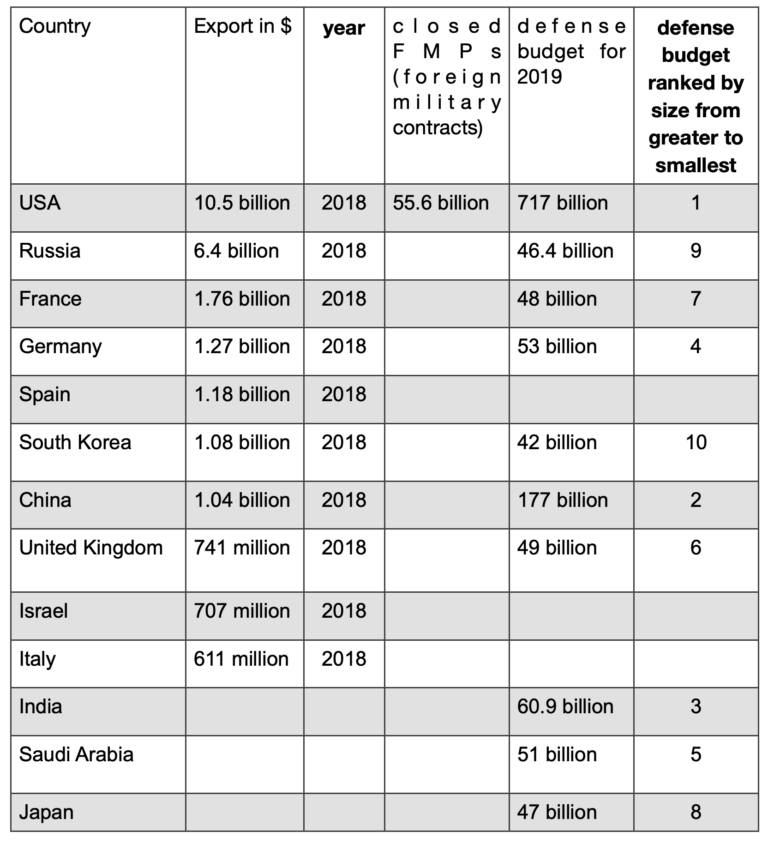
from: army-technology.com
These are the top ten exporters of arms for the year 2018. If the exports from all ten countries are added together, the total money earned globally through the sales of arms (war-making tools) is over 25 billion dollars and that is just the top ten countries for one year. The ten top arms budget for 2019 equals $1,291.3 billion dollars. These dollar figures represent the huge amount of money that some vast number of people are making from the carnage and blood that is part and parcel of Greenspan’s creative destruction. Greenspan, however, was not talking about the carnage and blood of war when he used his phrase for describing the destruction of thousands and thousands of people losing their paychecks which was their lifeline for their survival in the modern world.
1.293 trillion dollars for the year 2019 is a great sum of money. There is a strong, a very strong incentive to keep the war machines running because vast amounts of money are generated by these war machines. Additionally, war machines are only as good as the carnage and blood that they produce.
If there was harmony in the world, if peace ruled the international community, these vast amounts of money allocated on a yearly basis would be unneeded. If cooperation over competition was the guiding force of economic structure, then these war machines would become obsolete. Laws of physics, however, abound. The laws of inertia mean that once an object (in this case the economics of the war machine) has movement and momentum, then an equal force is required to bring it to a halt and then more force is required to move it in the opposite direction. The force of 1.293 trillion dollars is a huge force to overcome and redirect. What happens if this war machine is not abated?
Jacob Bronowski’s in Ascent of Man (copyright 1973) explains his concept of Stratified Stability:
Nature works by steps. The atoms form molecules, the molecules form bases, the bases direct the formation of amino acids, the amino acids form proteins, and proteins work in cells. The cells make up first of all the simple animals and then sophisticated ones, climbing step by step. The stable units that compose one level or stratum are the raw material for random encounters which produce higher configurations, some of which will chance to be stable. So long as there remains a potential of stability which has not become actual, there is no other way for chance to go. Evolution is the climbing of a ladder from simple to complex by steps, each of which is stable in itself.
Since this is very much my subject, I have a name for it: I call it Stratified Stability. That is what has brought life by slow steps but constantly up a ladder of increasing complexity — which is the central progress and problem in evolution. And now we know that that is true not only of life but of matter. If the stars had to build a heavy element like iron, or a super heavy element like uranium, by the instant assembly of all the parts, it would be virtually impossible. No. A star builds hydrogen to helium; then at another stage in a different star helium is assembled to carbon, to oxygen, to heavy elements; and so step by step up the whole ladder to make the ninety-two elements in nature. (Pages 348-349)
These two paragraphs have much to note and consider. First on my mind is the sentence: “So long as there remains a potential of stability which has not become actual, there is no other way for chance to go”. If there is “a potential of stability” then chance occurrences will continue until that potential stability is achieved. So is the universe without absolute laws? No, there appears to be laws that absolutely govern stability. Earlier in this essay, World Within World, Bronowski explains:
Carbon is formed in a star whenever three helium nuclei collide at one spot within less that a millionth of a millionth of a second. Every carbon atom in every living creature has been formed by such a wildly improbable collision. (Ascent of Man, page 344.)
Just as a sufficiently high temperature is needed for the collisions of two hydrogen nuclei to form helium there is no doubt that the collision of three helium nuclei will have some heat requirement for that collision. So there are initial conditions that must be met for the formation of helium and different initial conditions for the formation of carbon. If the conditions for the formation of helium and for carbon are not all present, then I surmise that helium and carbon will not be formed.
As I reflect upon Stratified Stability, I am of the mind that Bronowski’s explanation implies that the progression is toward stability. To my thinking, sustainability and stability are identical twin manifestations of the same concept. If what is formed is not stable, it will break apart, crumble, disintegrate, or otherwise cease to exist. That which is not stable by definition cannot be sustained.
Look around the world today and ask yourself if the path that has brought the human race to this point in time is stable and sustainable along this same path. If it is not stable, it is doomed to die. If it is not sustainable, it is doomed to die. If our current path is neither sustainable nor stable, then it must not be in harmony with the laws of sustainability or follow the laws pertinent to Bronowski’s stratified stability. The fix to avoid our self-annihilation is to recalibrate our lives and our decision-making paradigm to harmonize with the elements of stratified stability that will lead us to move upward to the next level of complexity. This is the crossroads upon which humanity sits.
We have spent our thousands of years of history as hominidae learning about and perfecting our responses to competition and the survival of the fittest. Moving to embrace and learn more about cooperation moved us from érōs into philía realities. Philía realities have moved us to become creatures inhabiting vast concrete jungles full of technological and scientific advancements, all of which have made humans the dominant creature of Earth. The downside to being the dominant creature is that our choices have brought us to this point in our history—to the crossroads of moving forward to the next level of advancement or to go out in blazing glory or fizzle out in prolonged degradation.
If my hypothesis is correct, that the next level of advancement along the evolutionary path of stratified stability is advancing beyond philía realities into agápē reality. Not to do so will be to become unsustainable and humans will go along the path of those elements unable to advance to the next level of evolution. A well-developed and expanding consciousness is required to make the next step forward.
The issue is not to defeat chance but to harmonize with chance. To achieve this harmony, consciousness, once developed and expanded, needs to reflect upon all that was learned and then act to facilitate initial conditions that enhance the probability that chance will easily combine proper elements to merge together. In this merging, what is needed will be formed to assist the human species in moving forward along the path of sustainable stratified stability to the next level for humans to experience.