Being UPLOADED
Preface:
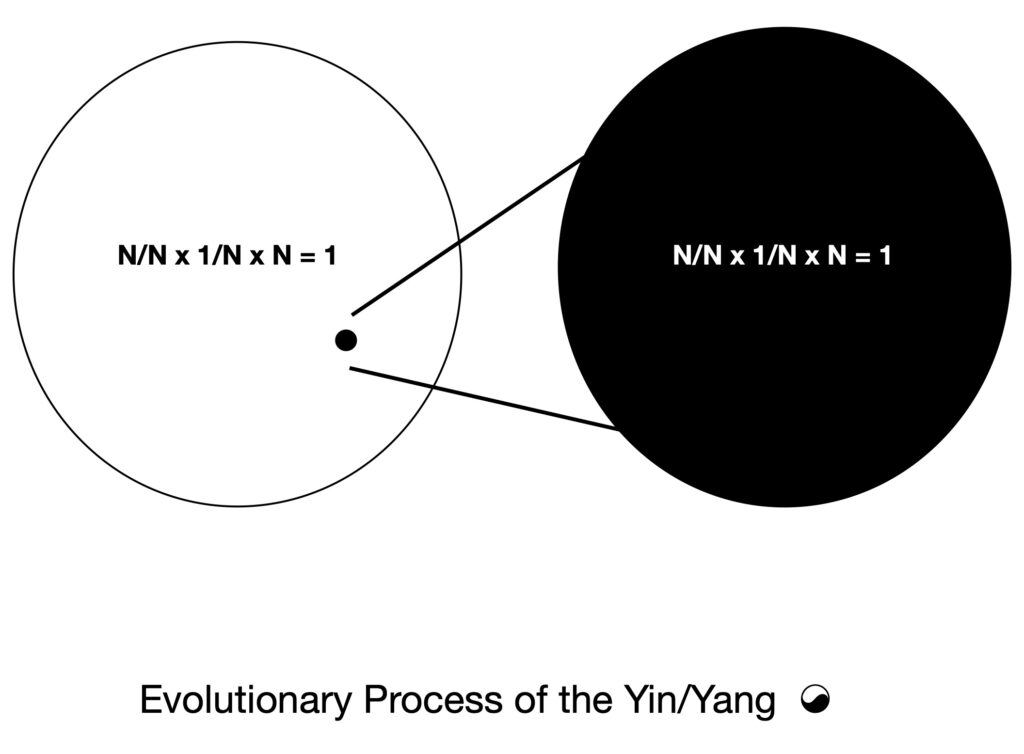
It is the intangible that moves or transforms the tangible. Look at the image on the title page of this section of this treatise. It is composed of lines, letters, words, phrases, an equation, the yin/yang symbol, a large dot and two circles. It is the juxtaposition of these ‘graphs’ representing ‘graphemes’ that convey the meaning that is present on that title page. To explain:
During my undergraduate college years I learned a simple chart when taking my Comparative Grammar class. It was a class taught by Dr. Louis Sheets. I attribute the learning of this chart to him. I always read this chart from the bottom line, “Phoneme/Grapheme to Morpheme” up to the top line, “Myth to Weltanschauung [worldview].” Dr. Sheets was a very learned man and used the German word, weltanschauung, which he translated for us as roughly meaning “worldview” in English. He strongly highlighted that while we, students, may understand this German word as meaning worldview, there is no word in the English language that has quite the same meaning as weltanschauung. I do not know German, so the nuanced meaning is lost to me and I am left to understand this chart below as the hierarchical progression from the basic unit of sound (phoneme) up to the particular worldview being presented.
Elements  (to) Arrangement
Mythic Weltanschauung [worldview]
Semantic Mythic
Syntactic Semantic
Morphemic Syntactic
Phoneme/Grapheme Morpheme
The suffix, ’eme’ was explained as “the smallest foundational aspect of the noun to which that suffix is attached. The phoneme is the smallest foundational unit of sound while the grapheme is the smallest unit of writing. The morpheme is the smallest unit of meaning. A specific example of the morpheme of plurality is the grapheme ‘s’ when it is attached to a noun like ‘cat’. ‘Cats’ is a word that uses the ‘s’ to indicate more than one cat. The phoneme is the sound that the ‘s’ makes when ‘cats’ is spoken. The phonemes for: c, a, t, and s, are the sounds combined when the word ‘cats’ is spoken. The graphemes: c, a, t, and s, are the letters written to indicate the spoken word,’cats.’
I would like to push this further if you will indulge me. Consider Euclidean geometry. The point, the line, or the triangle each has a specific meaning. The triangle, however, has several components that are in relationship to each other that altogether constitute the morpheme, ‘triangle’. In geometry the morpheme ‘point’ is made up of only itself, but the line segment is made of several points with clearly definable end points which can be designated as ‘A’ and ‘B’ on either side of all of the points that reside between ‘A’ and ‘B’.
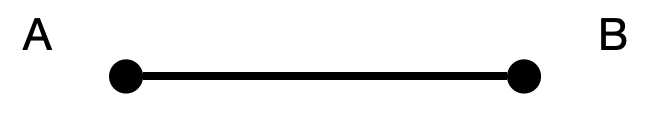
So, the morpheme, line segment, is made up of six morphemes: point, end, line, segment and 2 letters.
The triangle has three line segments that are connected at points A, B, and C. Since this is a triangle, the points where the line segments connect represent or convey another unique morpheme, the ‘vertex’. Points A, B, and C are vertices because they are the meeting points where two lines or line segments join to form an angle.
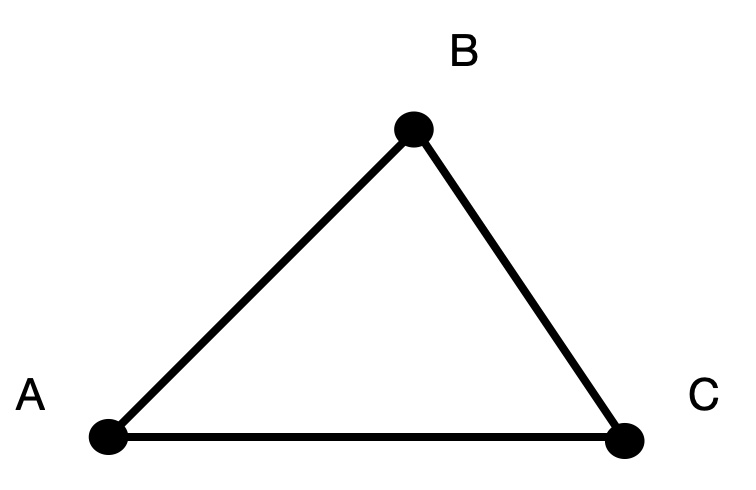
To list the morphemes which constitute a triangle we record the: point, line segment, vertex and angle, but angle is made up of vertex and line segments and a line segment is made up of end points, segment and line.
The syntax (arrangement) of line, points and end points constitutes the semantical line segment. The semantics of Euclidean geometry distinguishes it from the semantics of Hyperbolic geometry. The semantics of mathematics distinguishes mathematics from history.
Moving from the semantical to the mythical is tricky and a bit dangerous. The danger, to my thinking, emerges because individuals, cultures, and nations have strong emotional ties to certain myths that are highly valued. Caution is prudent in sharing one’s reflections on myths. Generally speaking, moving from myths to worldviews is more easily expressed. A worldview is simply the collection of all of the “myths” that constitute that worldview perceived. Such a statement is fairly innocuous because any given ‘myth’ has not been defined or described or even named. Individuals with strong beliefs are offended when, and if, those beliefs are termed myths because the word, myths, has the possible connotation of being less than reality. Demoting another individual’s beliefs as being myths might just be construed as an insult of high magnitude.
It is not my intention nor my wish to insult anyone. Nor do I seek to devalue any other individual’s belief system. Consider that some individuals’ worldviews have a very high respect and value for science as the epitome of truth or reality based on facts and not opinions. I have encountered some individuals whose worldview is that science is the end all, be all, while literature has more of an entertaining function and more of an amusement for children. In response to this point of view and with a mind to continue to focus on moving from the mythic to the diverse worldview level, please reconsider Jacob Bronowski relating Neils Bohr’s comment to Heisenberg:
“When it comes to atoms, language can be used only as in poetry. The poet, too, is not nearly so concerned with describing facts as with creating images.” (Page 349.)
The Ascent of Man (1973).
Bronowski does not treat Bohr’s observation as unscientific or absent of value. On the contrary, Bronowski finds Bohr’s observation remarkable. Bohr’s perception exemplifies the fullness of his consciousness. Bohr’s worldview combines science and poetry, science and literature.
I have come to understand that labels are just that — labels. Labels have use but labels are not reality. Labels are tags for morphemes that are trying to be conveyed. Labels (morphemes) are units of meaning that are arranged (syntactically) in such a fashion that the juxtaposition of morphemes create more complex morphemes that in turn become the building blocks of more morphemes such as a poem or a collection of poems or a story or a novel or a scientific treatise or a scientific theory and so forth and so on.
Undoubtably, Neils Bohr is a robust scientist, but he is more. His consciousness informs his science, his science informs his worldview. His worldview, therefore, is effected by his consciousness. In fact, to my thinking, his consciousness is his worldview. This compilation, One Bipedal Journey, is an expression of my consciousness, an aspect of my worldview. The totality of my consciousness is my worldview.
There are many, many diverse sounds that permeate the habitat of bipedal hominids. Sounds like the growl of a dog, the purring of a cat and the mating song of cardinals etcetera, have meaning but it is the sound of the bipedal hominid that is of interest to me at this time. Language developed first as an expression of sound. Writing developed after. Meaning perceived by bipedal hominids was first expressed in sound. As bipedal hominids’ meaningfulness grew, it was encapsulated into sound. Just as the source of a great river and all of its tributaries that forms a watershed all of which eventually finds itself emptying into the great ocean, so, too, does the mindfulness meaning of the ever growing and expanding collective of morphemes flow upward into the great reservoir of one’s worldview. It is from this source that I reflect upon the divine paradox.